
A Market Moment Defined by AI, Productivity and Capital
“There are decades where weeks happen, and there are weeks where decades happen.”
That quote from Malcolm Wood provided a fitting introduction to a discussion centred on one of the most significant economic and technological shifts currently underway: the rise of artificial intelligence.
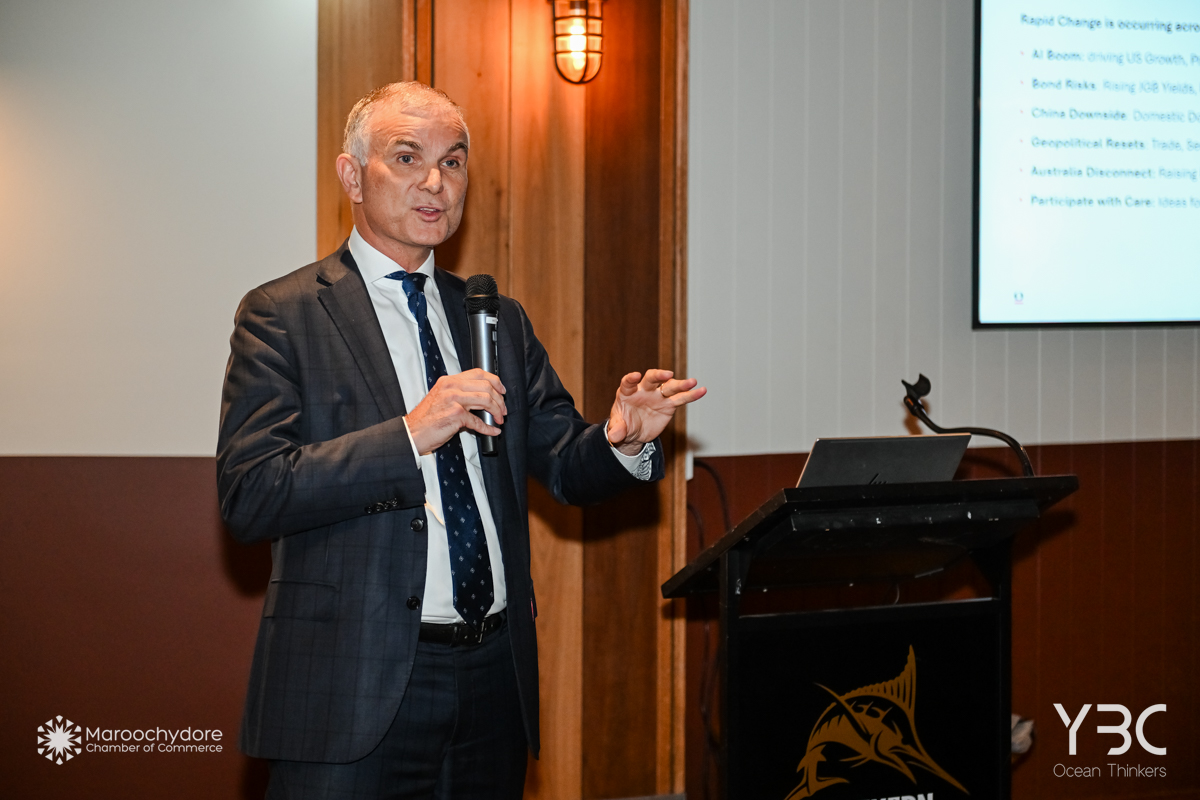
Speaking at a Maroochydore Chamber of Commerce After Hours event at Northern Grounds, Wood drew on decades of experience analysing financial markets and global economic trends. His presentation explored the scale of investment flowing into AI, the impact on global markets and the opportunities and risks facing investors.
One of the strongest themes of the evening was the sheer magnitude of capital being committed to artificial intelligence infrastructure.
Large technology companies are investing hundreds of billions of dollars into the computing power, data centres and supporting systems required to develop and deploy AI at scale. The pace of spending reflects growing confidence that AI will play a central role in future economic growth and business transformation.
That confidence is also evident in equity markets.
A small group of major technology companies now accounts for a substantial share of the value of the US stock market, highlighting both the market’s enthusiasm for AI and the concentration of investor attention on a handful of firms leading the race.
Beyond the technology sector, Wood highlighted the strength of corporate earnings in the United States and contrasted this with a more modest growth trajectory in Australia. Productivity was a recurring theme, with the discussion touching on the different economic outcomes being experienced across the two markets.
For business owners, the message was not simply about stock prices or investment returns. It was about understanding the forces reshaping the global economy and recognising how rapidly those changes are occurring.
At the same time, Wood emphasised the importance of perspective.
History provides numerous examples of transformative technologies generating enormous excitement and attracting vast amounts of investment. Railways, electricity and the internet all changed the world, but each also experienced periods of speculation, uncertainty and market volatility along the way.
The challenge for investors is distinguishing between genuine long-term value creation and short-term market exuberance.
That tension is particularly evident in today’s AI landscape. While there is broad agreement that artificial intelligence will have a profound impact on industries and organisations, questions remain around the timing, commercial returns and ultimate economic winners.
What is clear is that AI has moved well beyond the realm of emerging technology.
It is now influencing capital allocation decisions at the highest levels of global business, shaping market performance and driving conversations about productivity, competitiveness and future growth.
For organisations of all sizes, understanding these developments is becoming increasingly important. Whether through operational efficiency, customer experience, workforce capability or strategic planning, AI is quickly becoming a factor that business leaders can no longer afford to ignore.
If the discussion served as a reminder of anything, it was that significant economic shifts rarely announce themselves quietly. They emerge through changing patterns of investment, productivity and innovation, often long before their full impact becomes apparent.
And by almost every measure, artificial intelligence is already beginning to leave that mark.